
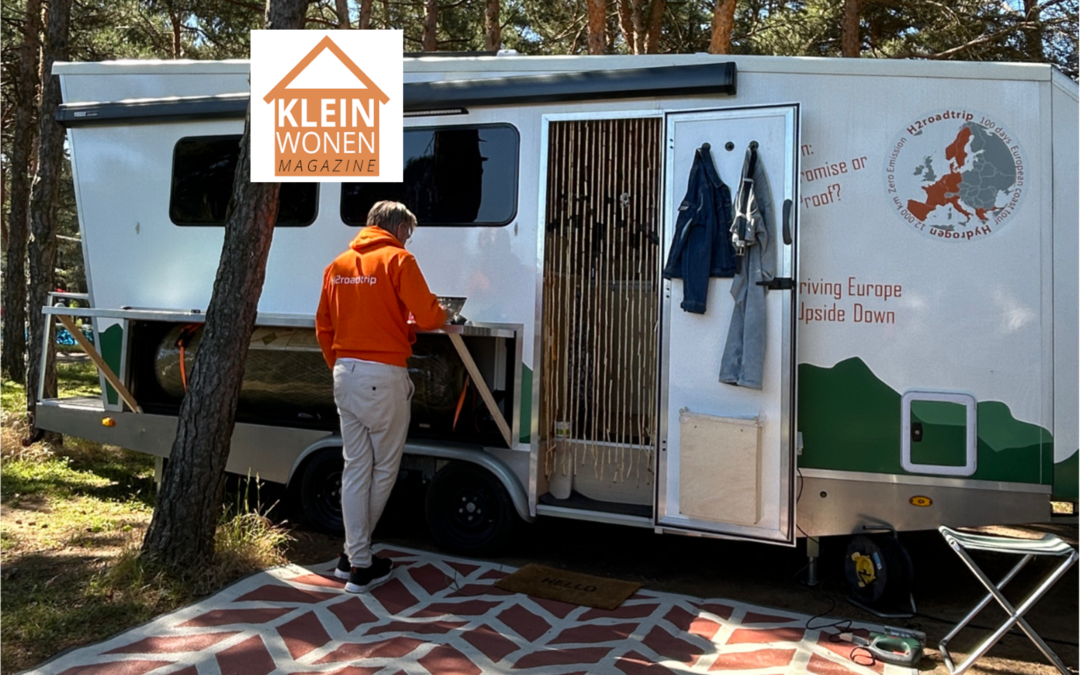
André and Els Molengraaf had a special shell tiny house built for their H2road trip, a journey from Oslo to Istanbul via the European coast, 12,000 km, through 12 countries in 100 days and zero emissions. They built the interior according to their own wishes around two large hydrogen tanks. They have now been on the road for almost two months organizing events to promote hydrogen as an energy carrier. But how do you like living in a tiny house? Els blogs about it for Klein Wonen Magazine.
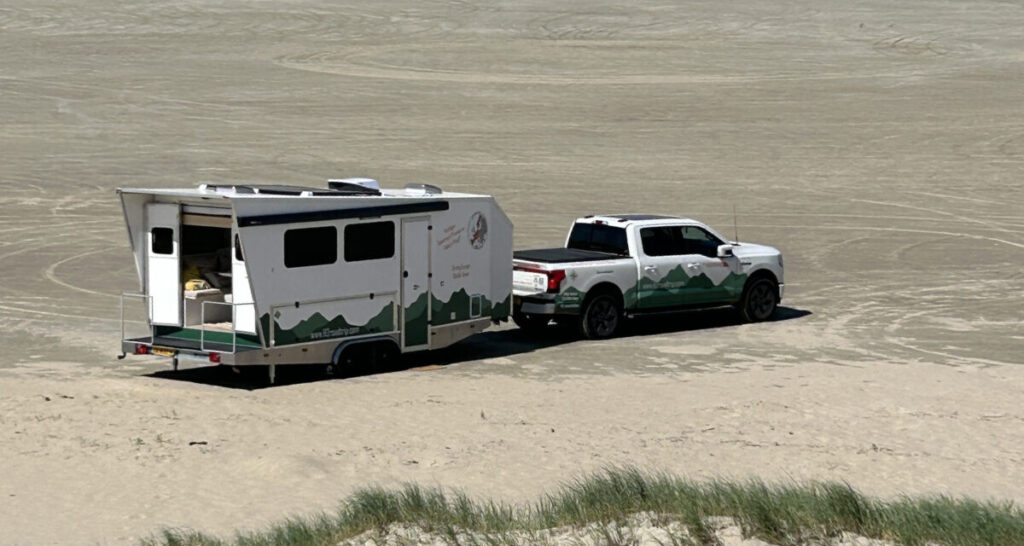
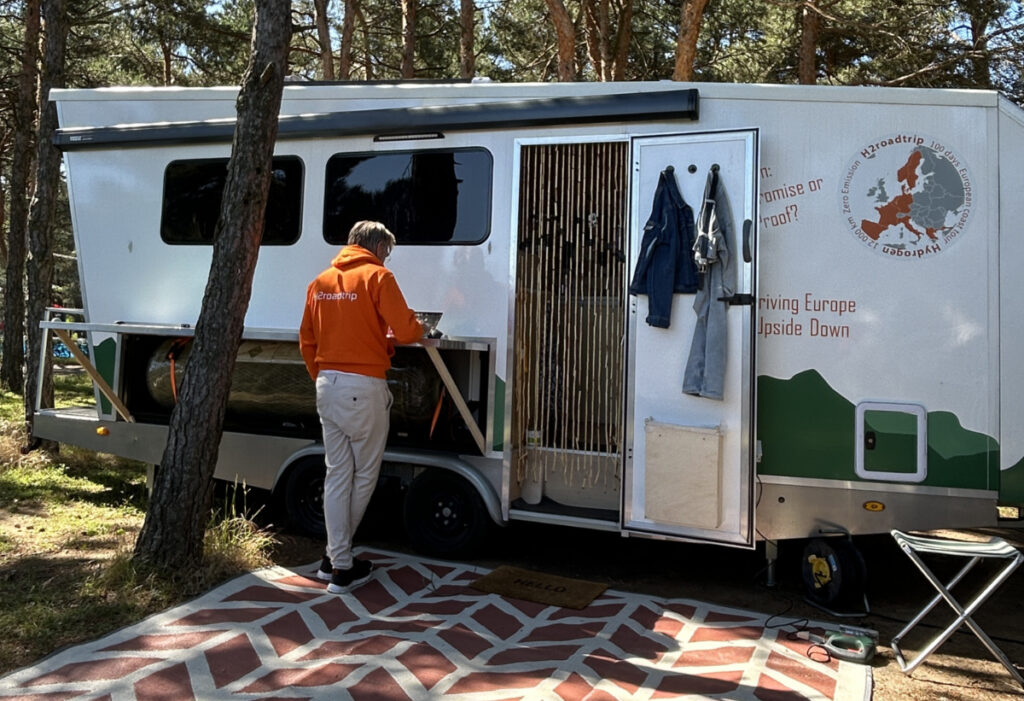
We live and work on the road in our beautiful little self-made house, which we are very proud of. We designed and built it entirely ourselves. We have two hydrogen tanks in our tiny house where we had to build around. So we really had to take that into account. So it’s really a custom-made tiny house. The hydrogen from the tanks is converted into electricity by a generator, which we can use to charge the car while driving.
ELECTRIC LIFT BED
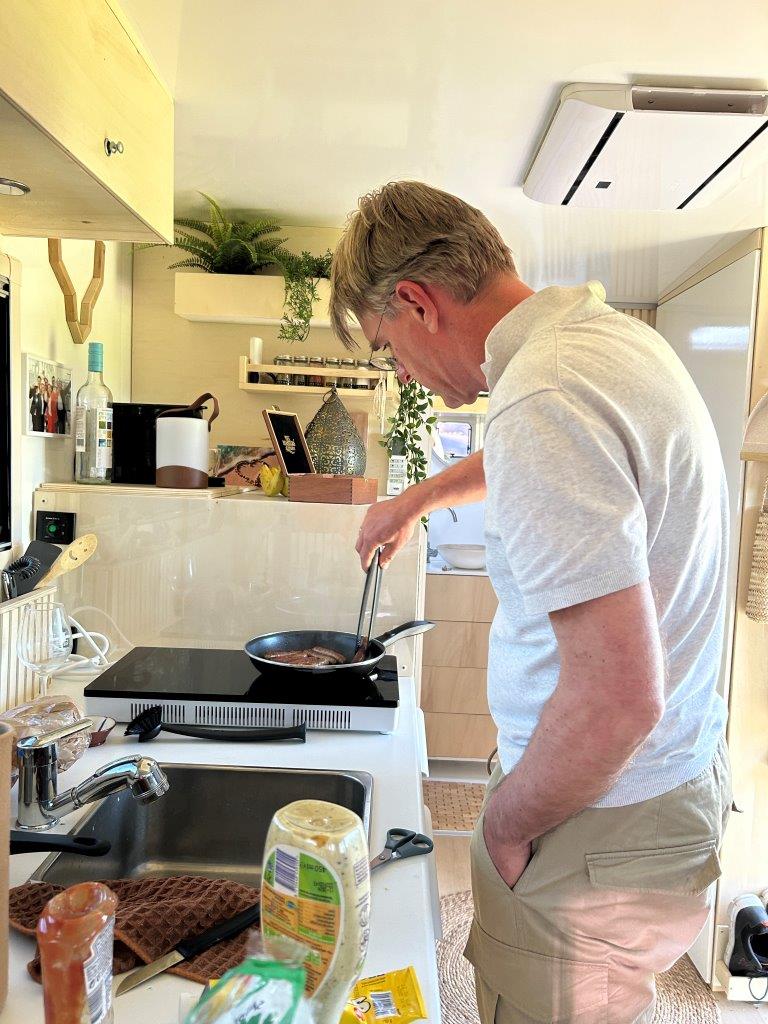
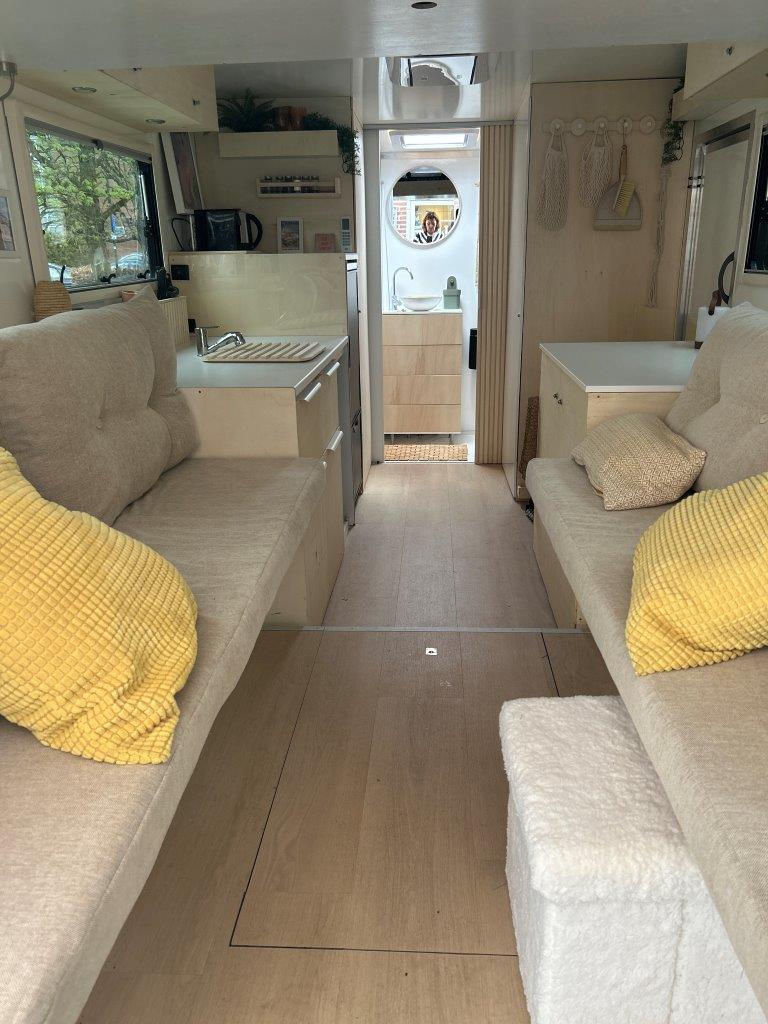
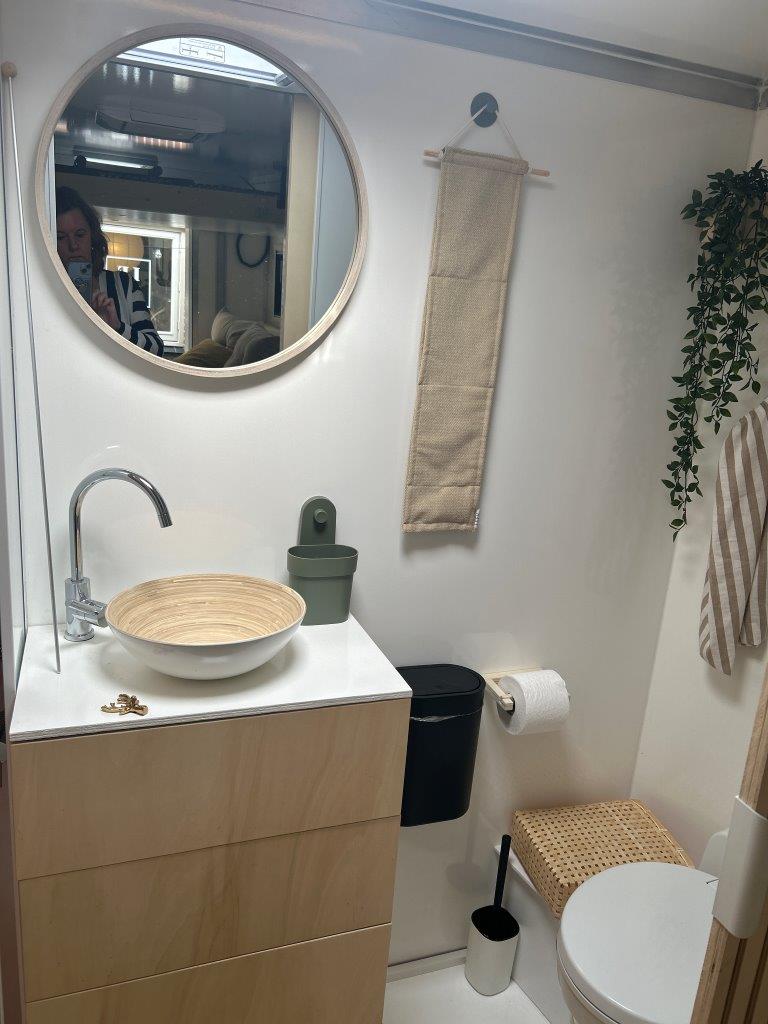
Life is so good. We have everything we need. We have created the layout in such a way that it all fits exactly. An electric fold-down bed, kitchen, shower, toilet and sink. We have installed two solar panels of a total of 800 WP on the roof and 5 kWh batteries and a Victron inverter, so that we can live off-grid for quite some time. This should actually be standard in every caravan, camper or tiny house to allow grit or vehicle independent travel. This allows us to make coffee or tea during a stop, bake sandwiches, whatever we want or stay at a campsite without needing electricity.
During the first few weeks we noticed that the electrical capacity was not sufficient for cooking on two burners of the induction plate. The fuses kept blowing. Also one stove and the kettle did not work. So that meant taking cooking into account. After two weeks we suddenly realized that we have two different groups of fuses, namely 6 and 16 amps. Did we connect this correctly? So no, we switched the group and it worked!
MOISTURE
We also had, in Scandinavia, that the kettle kept short-circuiting. But as it became less humid outside and inside, it turned out to work after all. So this had to do with moisture. We also had to do some caulking on the first nice days to seal some seams, but we had not gotten around to this yet. The climate unit, which both heats and cools, is a must for traveling in the spring. In addition, candles also provide warmth and coziness. 😉
LOTS OF WORKSPACE
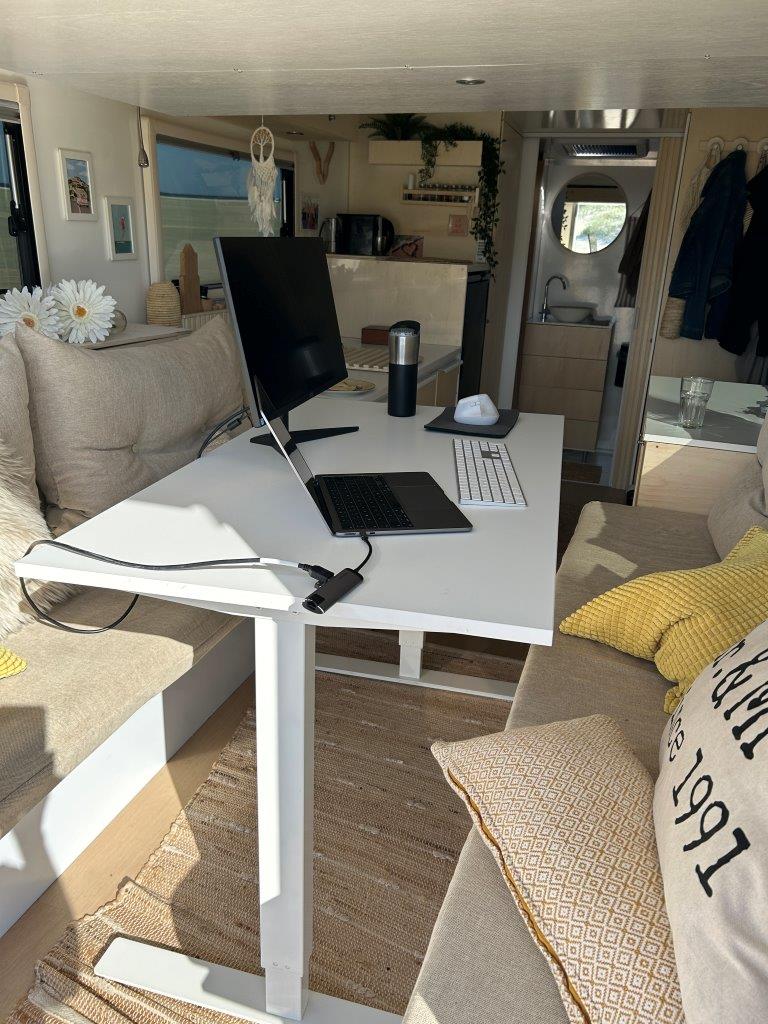
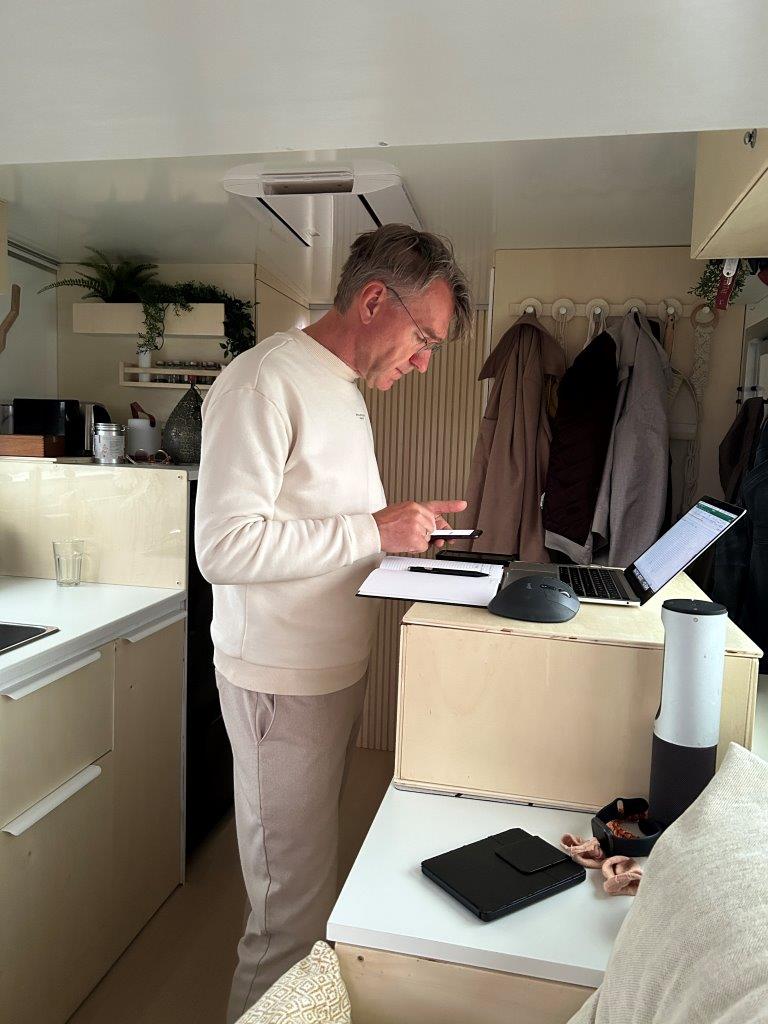
We opted to cook on a separate induction plate. This way we can store it and have more space on the countertop and we can also place it outside to cook there when it is very hot inside. Due to the 2.50 meter width of our tiny house, we were also able to create an extra deep countertop. This also gives you plenty of work space. Because we also work on the road, we have made a desk with a worktop at the same height and depth as the countertop. There is a box in the cupboard that we then place on the desk and from the box we remove the laptop, etc. to turn it into a standing desk.
WALL CONNECTIONS
What we would do differently structurally for a possible next time, is to make all wall connections of a material other than aluminum. The aluminum profiles now act as a heat and cold bridge, causing condensation to form on the profiles. Afterwards we knew, from experience with bus construction, that this always happens with aluminum profiles. Due to the mentioned 2.50 width of our tiny house and the fact that we have only made continuous low-level cupboards from the entry door, everything feels nice and spacious. We keep hearing that from people who come in and watch. They think it is so spacious and high (at most 3.10m).
We made the pull-down bed because we did not want to make our bed every night and wanted to sleep on good mattresses. So we opted for two slatted bases and two mattresses measuring 90 x 200 centimeters. Sleeping is important to be able to start the day rested, especially if you are on the road for 100 days. Unfortunately, the mattresses turned out to be slightly thicker and heavier than we thought. Raising it electrically requires some extra man/woman power to raise it.
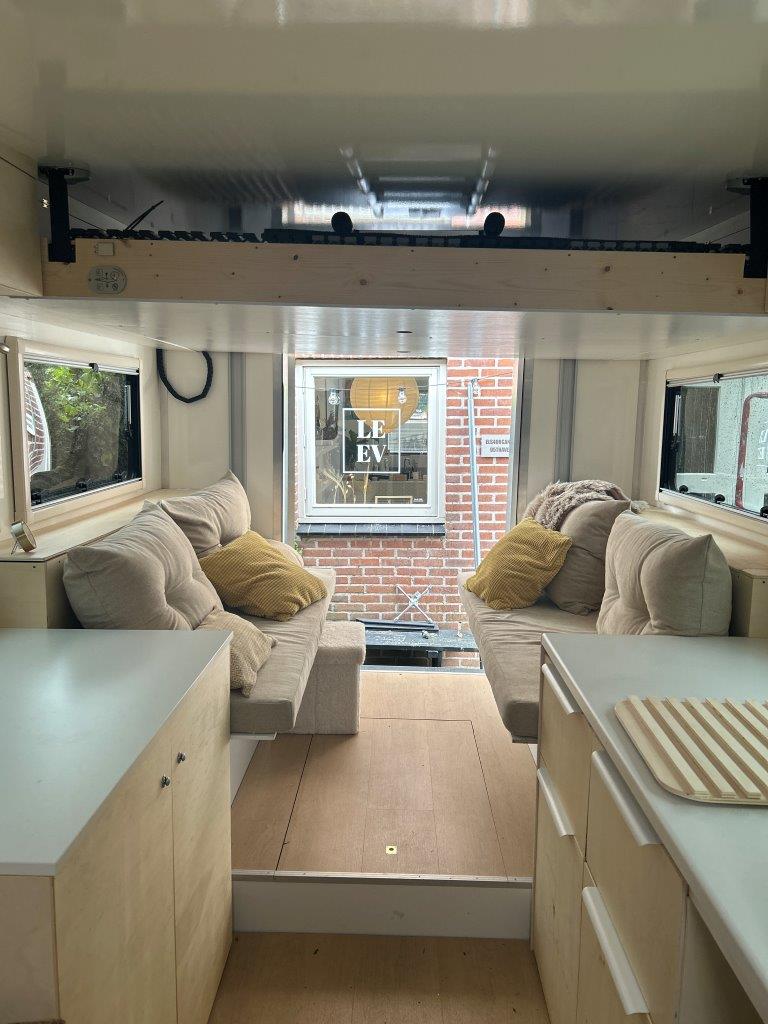
REALLY OUR HOUSE
We really enjoy our house. We made it with light colors and materials and that gives extra relaxing vibes. And because we have been working on it for so long, it’s really our own home. Our mission is going as expected. At the campsite and parking lots along the way, people spontaneously come up to us to admire our project and tiny house. We stand out with the appearance of both our tiny house and the electric pick-up in front of it.
RIGHT APP FOR CHARGING AND REFUELING
We recommend that people who travel emission-free through Europe check in advance which payment apps are available for electric charging and hydrogen refueling. We regularly spend a long time on site downloading the correct app and validating the associated payment. We also raised this during our visit to EU delegates in Brussels. There is already legislation that every filling and charging point must be accessible to everyone within the EU with normal credit cards. The implementation of this is certainly not ready yet. Fortunately, we made it every time and were not without electricity or hydrogen during our adventure.
Would you like to know more about our H2Roadtrip? You can follow us on Instagram, FB, YouTube, LinkedIn @h2roadtrip or website www.h2roadtrip.com. Would you like to see how we built our tiny house? Then watch the YouTube videos on @h2roadtrip.
Click here for the Dutch article.